Watching your dog grow old is a unique sort of pain. It’s not altogether unlike watching elder relatives age—but with pets, if you’re lucky, you get to witness the entire arc of their lives.
You take home the puppy. Feed him, clean him, teach him, come to love him in a way that feels singular in magnitude.
You protect him, as he protects you.
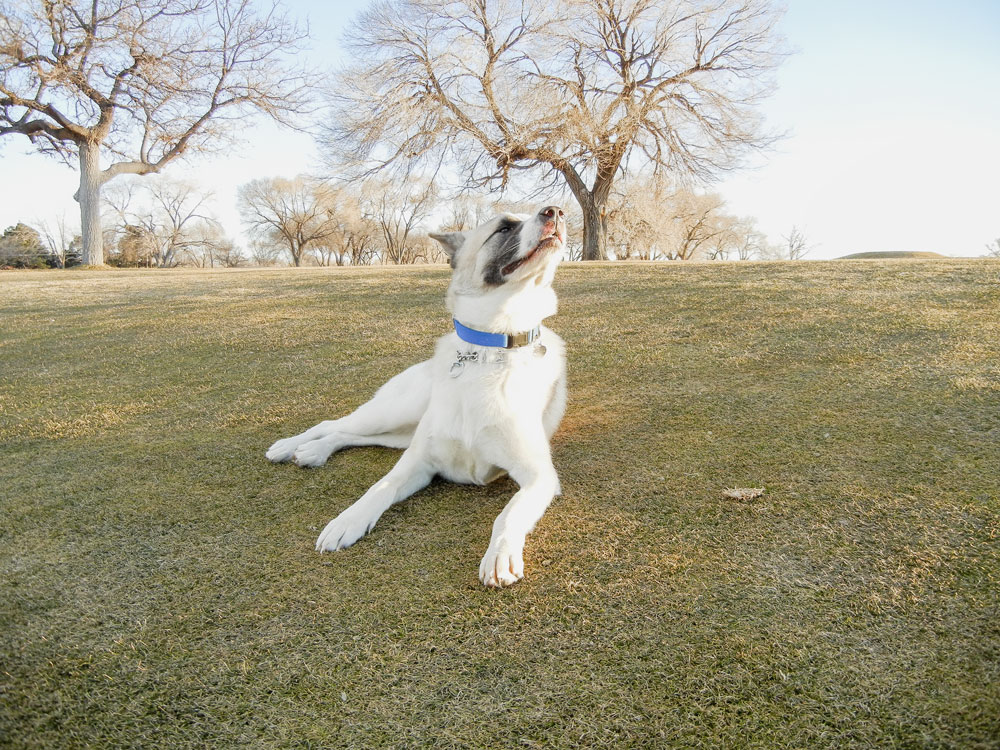
You watch him grow. The ball of fluff and floppy limbs learns how to walk without stumbling, begins to run a little faster, and so you quickly teach him what it means to come and sit and stay. Sometimes there’s a chase, but he’s still small enough to pick up when you reach him, and as you sweep the squirming rascal into your arms you kiss him on that extra-soft part of his head between his eyes, where the curve of his forehead meets the length of his snout. There’s a patch of white right there that takes the shape of a heart, and no marking has ever felt more appropriate.
You hold your cheek close to him and breathe in the sweet-and-sour puppy scent. You carry him to a safe place and set him down, watch as he tries again.


His legs grow long and his ears pop up, no longer folded into tiny triangles that wiggle with every step. Those ears seem like magic, the way they react when your hand lowers for a scratch. Even from behind, they sense you. And they feel otherworldly—like they’re made of velveteen.
His snout grows sleek and his tail bushes out, and soon he’s so big it’s hard to lift him. People look at you as you walk down the street holding him like a giant baby—but he’s still only a few months old, and not all of his shots have taken effect, and it’s your job to protect him on the city sidewalks from the invisible beasts that lurk beneath your feet.
In those early months, you wonder at times if it was all a mistake, usually at 3am, when he whines and scuffles and forces you from your bed to brave the icy winter wind. You wonder again when he chews through your computer cord, or your sock meets a warm puddle on your way to the kitchen, or you enter a room to find all of your mail torn to shreds and the leg of your chair gnawed to splinters.
RELATED: A place in the wild
But even then, the love has started to grow so fierce that you know you’d clean a million messes, buy a thousand cords, turn your furniture to kindling, do whatever is needed to keep him warm and safe.


He howls to music, and he stands next to you as you practice the piano, providing an unwritten harmony. You laugh, and sometimes you film him, and you learn which songs elicit the most impressive response. Occasionally, you play them for guests to show off his skills, and they marvel at his range.
And then he’s huge, suddenly. You can no longer pick him up without protest (his) or struggle (your own), and soon you stop trying, content to call him to your side.
It’s just the two of you most of the time. For more than a decade, he’s the face you wake to and the head you pat goodnight. You kiss him three times before bed—once at the top of each velveteen ear and once on that soft spot on his forehead, the same place you kissed him when he was new.
When you say goodbye to others in your life—lovers, towns, family—lost to disconnection or death, he’s there. You come home to him after those wretched days and hold him close, feel his tongue on the back of your hand, squeeze him and tell him it’s just the two of you again.
Me and you.
When he eats something he shouldn’t, or he seems especially tired, or perhaps you find a small, squishy lump at the top of his hip, you panic. You rush him to the vet, pay anything they ask, pray to whatever god you believe in to protect him. You refuse to leave his side, and the vet lets you stay.
On those beautiful days, when you’re in the woods or some other form of wild, he walks with you in perfect step. He stays close, stopping only momentarily to sniff a flower or stump and leave his mark. He runs to catch up, and you run your hand along the length of his back, which is easy to do—he’s so tall you don’t even have to bend down.
You feel the crisp of leaves and twigs and pine needles with each step, and you turn your head to the trees and breathe in the mountains, and it’s all the more spectacular because he’s there with you.


In the winter, when the world is so cold your neighbors dare not venture outside, he’s at bliss. You bundle yourself in five layers, wear your warmest pair of shoes, and trudge out, eager to see his face the moment he recognizes snow.
The world is yours on those days. The parks are empty, filled only with wind and different shades of ice, and you can unclip his leash and watch him prance and sprint and jump and play. He looks to you, and you run with him, chasing and being chased in turn, and the heat from your panting and his joy keep you warm.
You stay out as long as your toes can bear it, and when you return home, you smile as you watch him sleep, listen for soft snores and the scuffling of twitching feet.
You run with him, chasing and being chased in turn, and the heat from your panting and his joy keep you warm.
At night, you’re no longer afraid, because you know if anyone ever tried to hurt you again, he’d be there. When worry swells in your chest, you reach for him and feel his side rise and fall with sleep, and you know you’re okay.
In fact, he’s the reason you sleep at all.
The years go by much faster than you thought. The stumbling pup turns stoic, so handsome you’re stopped nearly every time you leave the house by people who ask you what kind of dog he is. It turns into a joke with the lengths people go to for an answer—calling the question from across a busy intersection, stopping their car and running to you in the middle of a park as you watch with disbelief.
You always feel a little guilty, but also proud, when you tell them he’s not one breed—he’s one-of-a-kind. They aren’t likely to find a dog like him.
You never knew how beautiful he’d grow to be when he was little, all feet and barely a whiff of a tail. You adopted him from the shelter, where he was born, and their guess was as good as yours.
In a moment, he can switch from majestic to absurd, with nothing more than the looks he gives you from across the room. Sometimes he sleeps with paws spread to his side like little fins. Other times, you catch him with his legs crossed, or sitting up straight on the couch with his belly out, as though he were waiting for you to hand him the remote.
He’s so tall that sometimes when he starts to get off the couch he stops midway, with his back legs still sitting and his front legs perched in front of him, as though he’s a house on stilts. He’ll stay that way for awhile, so you suppose it must be comfortable. You call him silly and smile.
And then one day you begin to notice it takes him a little longer to stand. Instead of bolting up the stairs, he goes one step at a time, his hips wiggling along the way. You give him extra supplements that are supposed to help his joints, and they do seem to make a difference.
Still, somehow 10 years have gone, and as much as you want to deny it, you see the gray creeping around his face.
You take pauses on walks, let him rest as long as he likes, factor the extra time into your morning and evening spells around the block. He likes to sit on the front stoop while you tend the flowerpots, and some days, he’d rather stay there than walk at all, and you let him. You bring a book or play mindless games on your phone and sit out there with him, watch with him as people pass by—and it’s this way that you get to know many of your neighbors.
When he starts having trouble going up the stairs, and you see his back legs buckle under him, you take him to the vet. You hope it’s something like arthritis, something that can be managed with pills and supplements and maybe a harness, but the vet tells you it’s something else that happens to a lot of large dogs. Something called degenerative myelopathy, which is just as scary as it sounds. It’s neurological, and it will progress. His back legs will weaken and eventually go limp. It will move up his body until he can no longer walk at all.
You hear the news but don’t really hear it. Maybe it will move slowly, you think. Maybe we still have years. You cry, and you worry, and you do everything you can think of to help slow the spread of this thing that will one day claim your boy.
Again, time moves fast. Months turn to a year, almost two years, and you’ve watched as the rests on walks have gotten longer, as he’s no longer able to bring himself up on your bed, as he can only make the trek to the top of the stairs if you lift his harness along the way.
His appetite is strong and he still plays, and this brings you comfort. You invest in more toys that can be played with while lying down—puzzles, treat balls, sticky mats you smear with peanut butter.
But time continues to come for you both. You, yourself, were so young when you found him. Only 26. A babe. And now here you are at 39, and your puppy, small enough to hold with one hand, a giant who’s just turned 13.
He’s losing weight even though he eats, and he sleeps most of the day. More and more, you notice he doesn’t want to move from his bed.
You start making all of his food, hoping the fresh flavors will entice him to eat even more, and it seems to work, but still, you can see the bones of his hips.
You’ve given up on daily walks, since you know how hard they are for him, and so you’ve started using pads, which he’s adjusted to well. Now, though, he’s losing control of his bladder, and so you get him those bands that wrap around his belly like an absorbent cummerbund, and he doesn’t seem to mind.
These days, he doesn’t stand without help. And often, as soon as he does stand his legs give out beneath him. You don’t know what else to do, so you return to the patterns of his youth—wash him, feed him, clean up after him, help him learn new ways.
You know with each day that your time together is closing in.
It feels deeply unfair and against nature that you should still be so young, and your boy, the closest thing you have to a child, should be so old.
He has trouble turning over now, and so you learn how to help him, recognize the signs that tell you he wants to move. You must lift him entirely to get him from one room to another, but because he’s lost so much weight, you can manage.
He’s lost interest in his toys and games, leaves his food untouched but will occasionally accept treats, and all of this worries you deeply. You have trouble sleeping. You break into tears suddenly and profusely, as though someone inside your brain is turning a faucet on and off at whim.
It feels deeply unfair and against nature that you should still be so young, and your boy, the closest thing you have to a child, should be so old.
And then, one day, something inside you says it’s time. You think maybe he’s the one who told you, though you don’t know how. You call the vet, who tells you to call another vet who can come to your home, and so you make the rounds—research the thing you never wanted to research, make the calls you dreaded for 13 years. And you find a nice man who’s free the day after tomorrow.
You tell yourself it’s just a checkup. A “quality-of-life” evaluation, as they call it. But you know at the very core of you, hushed as the voice may be by the will of your thoughts, that the day has come.
You haven’t really left his side for weeks, but now you’re like glue. You lay him next to you on the bed and stroke the tips of his ears, those little triangles that are somehow still as soft as they were when you first brought him home. You think about how much you’ll miss them, and the whole of him. You try to keep your tears quiet, because you don’t want him to worry.
On what will be his last night, you feed him a smorgasbord of meats and treats. He likes the rotisserie chicken the best, and you’re so thrilled to see him eating—with a voracity you haven’t seen in weeks, despite the home-cooked meals—that you trick yourself one last time into believing it isn’t really the end. This brings you the smallest morsel of comfort.
After he’s eaten and fallen into a half-sleep, you lay your head next to his and stroke the side of his face with your palm and thumb. You sing him the songs your mother sang to you when you were young, the ones that still feel like home. You sing them quietly, almost in a whisper, for the crackling of your voice won’t let you go higher.
You wake on the day convinced it’s not the last day, but when the nice man arrives and you lead him up the stairs, each step feels heavier than the one before.
He looks at your boy and does his tests, and he tells you gently that his time is near. Very near. He’s slipping in and out of consciousness. The disease has finally worked its way up his spine and rendered him immobile. He will likely pass naturally in the next 24 to 48 hours, the man tells you. He’s not in pain, but in those moments of waking, unable to turn himself, he’ll become anxious and distressed. You know you can’t allow it. You worry you’ve already waited too long, greedy for time.
You sob, and look to your boyfriend, who’s been stronger throughout all of it than you ever expected, and plead for reassurance that it’s the right thing. He holds you and says yes, you’ve done everything you can. It’s time.
You sit crosslegged on your bed and hold your boy’s head in your lap, leaning down to kiss his cheek, his forehead, his ears, every piece of him within reach. You offer him more pieces of rotisserie chicken and he wakes for a minute, has another moment with you as he plucks the tidbits from your hand. It’s a gift, that moment, and you savor it.
As the vet does what he has come to do, you stroke your boy’s face and coo to him gently, tell him you’re there, always there, that he’s safe and loved—the same words you’ve repeated in his ear for 13 years, the ones that have been etched into this unknowable force that exists between you.
When it’s over, you wail, howl, keen.
You can’t watch them take him away, so you hide in the next room, fall to the floor and wrap your arms around yourself and try to slow your breath as you rock.
You’ve always known that when the day came, it would rip you to shreds, that it would be your undoing, at least for a time. You knew you would grieve as you did when you lost your mother and other great loves. But this time, there would be no soft face to come to your rescue. No tongue on the back of your hand. No forehead to kiss. It would no longer be me and you. It would be you alone. And it would be your job to pull back the pieces. Your job to stand. Your job to navigate the world without him. To learn how to sleep again. To not listen for small footsteps in the night.
As six hours pass and then 24, as one day becomes a week, a month, a season—as the hours continue to tick away, you try not to become lost in your grief. You feel the echo of him, and try to let it bring you peace.
Sometimes, you succeed.
You know that when the months have turned to years, you’ll still feel him by your side. You’ll accept the life he lived and learn to celebrate, not mourn. You know you’ll always miss him. Always love him. Always walk with him. Always call him your home.



0 Comments