For example, try setting a reminder to take a few sips of water every 30 minutes, or set a reminder to finish drinking your current glass of water and refill it every hour. For example, one SMART water-consumption goal might be to drink 32 ounces (960 ml) of water per day. Before you decide to drink more water, you have to understand your body’s fluid needs.
What’s the recommended daily water intake?
Exhaustion from heat strain occurred in 9 of 12 (75 percent) subjects when receiving neither water or salt, and 3 of 41 (7 percent) subjects when receiving only water. More recently, normal subjects acclimated to heat attempted 140-minute treadmill walks in a hot-dry environment when euhydrated and when dehydrated by 3, 5, and 7 percent of body weight (Sawka et al., 1985). All eight subjects completed the euhydration and 3 percent dehydration experiments, while seven subjects completed the 5 percent dehydration experiments. During the 7 percent dehydration experiments, six subjects discontinued after completing an average unimeal app of 64 minutes. As physical activity level increased, mean total water intake per day increased for both men and women. Men with low physical activity had the lowest total water intake per day (3.15 L), followed by moderately active (3.36 L) and highly active (3.63 L) men (Figure 3).
Consuming inadequate amounts of water increases the risk of dehydration, kidney stones, and poorer cognitive performance (3,4). Differences in water intake have been reported by age, race and Hispanic origin, and physical activity (5,6). This report provides updated estimates of mean daily total water intake for U.S. men and women aged 20 and over in 2009–2012. Until recently, there was little interest in collecting data on water and drink and beverage intake.
Body Weight Changes
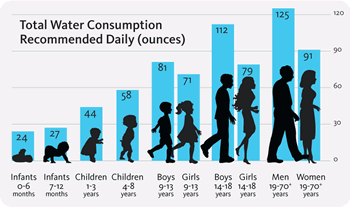
But if you’re hydrating well, being active, and focusing on good nutrition, it can help support your weight loss goals. Doesn’t it seem like everyone you see has a cute reusable water bottle sticking out of their bag? Indeed, it’s become much easier to stay hydrated in the last few years—and yet, people still struggle. On top of that, we think we know how much water to drink per day, when in fact that goal number of ounces should actually be a little different for everyone. In fact, experts say it can even vary for you based on what you do in any given day.
Why dehydration is more likely to affect older adults
This proactive approach will help you find the optimal balance of hydration that supports your overall well-being. Besides water, herbal tea and fruit-infused waters can also help keep you hydrated. Limit sugary and caffeinated drinks to avoid dehydration caused by their diuretic effects. You can ease premenstrual discomfort and reduce bloating by drinking lots of water before your period, as well as during. A recent study of young women with dysmenorrhea — very painful menstruation — found that drinking more water shortened their cycles, eased pelvic pain, and lessened their need for pain relief. But while this is a practical method, urine color may not be the best way to determine hydration.

How to Stay Hydrated for Better Health
The use of cold carbonated drinks and sugar-sweetened beverages, such as regular sodas and energy drinks, can increase risk or worsen symptoms of dehydration and should be avoided. This article discusses the importance of drinking water, how much water to drink and the benefits of staying hydrated. Understanding the value of staying hydrated helps you make wise choices about drinking water for optimal health. Anything that makes you sweat — a sauna or a hot tub, time outside on a hot, muggy day — will cause your body to lose fluid. Learn what foods and beverages can help you stay hydrated, and get the facts on how much water to drink each day.
What are some other health benefits of meeting hydration needs with foods?
Previous studies have shown that adults aged 60 and over are among the most vulnerable to dehydration (4,7). This report found that men aged 60 and over consumed 2.92 L, roughly 0.8 L less than the adequate intake, and women aged 60 and over consumed 2.51 L, approximately 0.2 L less. Fluid by individuals 20 to 64 years old as provided by the 1977–1978 Nationwide Food Consumption Survey and the 1994–1996 Continuing Survey of Food Intakes by Individuals (CSFII) (Heller et al., 1999).
- This accessibility promotes more consistent hydration habits, as you are less likely to delay drinking water due to waiting times.
- Athletes must find that right balance to help them reach their peak performance.
- Similarly, daily water intake recommendations vary based on pregnancy and breastfeeding.
- On top of that, we think we know how much water to drink per day, when in fact that goal number of ounces should actually be a little different for everyone.
- In addition, urine osmolality is increased when osmotically active solutes are excreted, such as glucose in patients with uncontrolled diabetes mellitus (Tilkian et al., 1995).
- These databases and tables must be specific to the study population and have inherent limitations [21] including coding errors.
When You Want to Lose Weight
Meaning, you’re going to be taking in wildly different amounts if you’re using 8-oz glasses vs. 16-oz glasses as your measurement. Advice to drink eight glasses a day isn’t wrong—it’s just not very precise. Non-Hispanic white men (3.60 L) and women (2.85 L) had the highest water intake, followed by Hispanic men (3.33 L) and women (2.58 L), and non-Hispanic black men (2.92 L) and women (2.41 L) (Figure 2).
Signs of Dehydration
In contrast, sweat sodium and chloride levels of healthy individuals seldom exceed 60 to 70 mmol/L. Nonetheless, 6 hours after ingestion, there was an antidiuretic phase, which lasted up to 12 hours post-alcohol ingestion (Taivainen et al., 1995). This could have been a result of a high serum osmolality that stimulated arginine vasopressin, resulting in water reabsorption (Taivainen et al., 1995). The effects of ethanol appear to change during the course of the day and may depend on the amount of water consumed at prior meals (Stookey, 1999). Thus, based on these limited data, it appears that the effect of ethanol ingestion on increasing excretion of water appears to be transient and would not result in appreciable fluid losses over a 24-hour period.
The National Academies
Ensuring adequate hydration is crucial for maintaining overall health and vitality. Had lower (relative to men) total water intake values by approximately 0.4 L/day early and late in life and by approximately 1.0 L/ day from 14 to 30 years of age. Differences in daily total water intake are probably somewhat due to differences in body size, physical activity, and climatic exposure. Urea, a major end product of metabolism of dietary proteins and amino acids, requires water for excretion by the kidneys.
What are the signs of dehydration?
However, the utility of using the prevention of urinary tract infections as an indicator of adequacy is not adequately established on a quantitative basis to be used as the criterion on which to base recommended intakes of total water. Both the singular and combined effects of plasma hyperosmolality and hypovolemia have been demonstrated as mediating the reduced heat loss response during exercise-heat stress (Sawka, 1992). Advantages conferred by high aerobic fitness and heat acclimatization (Buskirk et al., 1958; Sawka et al., 1983b). Women and men who are of comparable physical fitness and heat acclimatization status appear to respond similarly to dehydration and exercise-heat stress (Sawka et al., 1983b). Body water deficits can adversely affect anaerobic exercise performance but do not appear to alter muscular strength. Table 4-12 lists a summary of investigations concerning the influence of dehydration on anaerobic exercise performance.
Some medications like diuretics can also make you lose water, so replace it by increasing your water intake. Any activity that makes you sweat means you’re losing fluids, so you should drink extra water to compensate for the loss. If you primarily walk or stand, you’ll most likely need more water than if you mainly sit. If you eat 3 meals per day, this adds an extra 3 cups (720 ml) to your daily water intake. When exercising vigorously or sweating, children from 9-12 years of age generally need to drink about 3–8 ounces of water every 20 minutes to stay hydrated. Consumption of water from fluids and foods by healthy people in temperate climates, a Tolerable Upper Intake Level was not set for water.
However, this variability may, at least partially, be explained by the inconsistency in methodologies used as none of surveys used a dietary assessment tool validated for total water intake or beverage and drink intake. It is reasonable to suggest that this may result in incomplete data collection and it raises questions on the validity of the recommendations. The relationship between water consumption and health warrants further investigation, and robust methodologies are essential to ensure that these data are accurate and useful for setting public health priorities and policies.
A similar threshold was reported by other investigators (Sharma et al., 1986). Table 4-6 provides studies examining daily water turnover for adults in a variety of conditions. These values are generally higher than in water balance studies because subjects are often more active and exposed to outside environments. Daily water www.hellopeter.com/unimeal turnover rates were approximately 3.2 L and 4.5 L for sedentary and active men, respectively. Several studies found daily water turnover rates greater than 5 L; presumably these were more active persons who may have encountered heat stress. Women generally had approximately 0.5 to 1.0 L/day lower daily water turnover rates than their male counterparts.

0 Comments